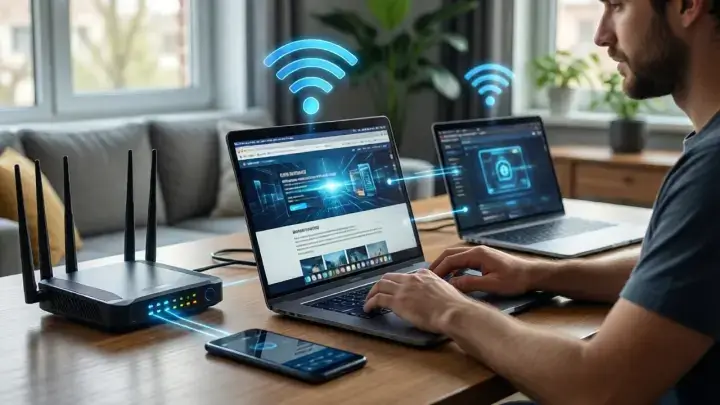

Searching for “www. myinternetaccessnet” can lead to an unexpectedly confusing trail. The phrase looks like the name of an internet provider, a VPN service, or perhaps a customer-access portal. Yet the website currently associated with the search term tells a more complicated story. www. myinternetaccessnet presents itself as a source for cybersecurity, technology trends, smart living, internet connectivity, and online privacy, while several of its articles describe a much more specific VPN-style service.
That distinction matters. A website can publish information about VPNs without actually operating a VPN network, just as a technology publication can discuss broadband without being an internet service provider. In the case of www. myinternetaccessnet, the available evidence suggests that readers should separate what the website says about itself from claims that can be independently verified.
The result is less a conventional profile of a company and more an examination of what sits behind a surprisingly searchable name: what the site currently publishes, why the keyword is associated with VPN and internet access, what information can actually be confirmed, and which parts remain unclear.
| Fact | Details |
|---|---|
| Full Name | www. myinternetaccessnet |
| Date of Birth | Not applicable; this is a website and domain rather than a person |
| Place of Birth | Not applicable; the site has no verified place of origin comparable to a person’s birthplace |
| Nationality | Not applicable; the website does not establish a nationality |
| Profession | Technology and cybersecurity information website |
| Famous Role / Known For | Articles about internet access, cybersecurity, VPNs, privacy, technology trends, and smart living |
| Years Active | Web presence dates to at least 2021, with the site active in 2026 |
| Net Worth | Not applicable; no verified financial disclosure for the website or an operating company was identified |
| Marital Status | Not applicable; www. myinternetaccessnet is not a person |
| Spouse | Not applicable |
| Children | Not applicable |
| Notable Works / Achievements | A large collection of articles covering internet connectivity, online privacy, cybersecurity, VPN concepts, smart technology, and related digital topics |
The first clue is in the name itself
The wording behind the keyword creates much of the confusion.
“www. myinternetaccessnet” sounds like a customer-facing utility. A visitor encountering the name without seeing the website might reasonably expect an account portal where an internet customer can pay a bill, manage a connection, download software, or contact technical support. The addition of “.net” reinforces that impression because internet-service companies have historically used network-oriented domain names.
But the site’s own About page gives a different description. It says www. myinternetaccessnet focuses on cybersecurity, technology trends, and smart living and describes the platform as a source of knowledge and insight rather than clearly identifying itself as a conventional broadband carrier. Its navigation is organized around categories such as Cybersecurity, Smart Living, and Tech Trends. That structure looks considerably more like a digital publication than a traditional ISP customer portal.
This distinction is the most important starting point for anyone researching the keyword.
The site should therefore not automatically be described as a broadband company simply because its name contains “Internet Access.” Nor should it automatically be treated as a VPN provider merely because several articles use VPN terminology.
The more defensible description is a technology-focused website whose content heavily discusses internet access, privacy, cybersecurity, and VPN-related subjects.
Why people associate www. myinternetaccessnet with VPNs
The VPN connection is not imaginary; it comes directly from the site’s own publishing history.
Several pages describe www. myinternetaccessnet as a VPN-oriented service. One article describes the platform as a VPN designed to improve security and anonymity, mentioning encryption, server locations, multiple devices, bandwidth, and setup. Another article discusses features such as a kill switch, IP masking, encryption, global server access, and an alleged no-log policy.
More recent material published in 2026 continues this direction. A September 2026 article explains VPN fundamentals and recommends evaluating providers according to factors such as independent audits, modern protocols, leak protection, and kill switches. Another August 2026 article goes further, describing www. myinternetaccessnet itself in terms of encryption, WireGuard, OpenVPN, DNS leak protection, split tunneling, multi-hop routing, dedicated IPs, and other technical features.
The problem is not that these concepts are impossible. All of them are legitimate VPN concepts. The problem is the difference between explaining a technology and proving that a particular company operates that technology at the scale being described.
For someone researching the keyword, that distinction is essential.
A VPN provider normally leaves a much more substantial commercial footprint: identifiable applications, download channels, documented server infrastructure, subscription mechanisms, privacy documentation tied to the actual service, independent security assessments, and a recognizable customer-support ecosystem. Those are the kinds of evidence that allow a reader to distinguish a real operating VPN business from a website that publishes VPN-related material.
The pages found on www. myinternetaccessnet do not, by themselves, establish all of those things.
What the website says it actually does
The About page is considerably more restrained than some of the site’s promotional-looking articles.
It describes www. myinternetaccessnet as a platform intended to help readers understand the digital world, with an emphasis on cybersecurity, technology trends, smart living, and protecting one’s digital footprint.
That description fits what can be seen across the site.
The homepage includes material about public Wi-Fi, VPN basics, internet connections, parental controls, Wi-Fi coverage, router selection, remote work, privacy, cybersecurity, smart-home technology, and related subjects. There are also articles about topics that have little obvious connection to the core www. myinternetaccessnet identity.
This makes the site resemble a broad technology publication rather than a narrowly focused connectivity service.
The content model is important because it changes how readers should interpret search results. When an article says that “www. myinternetaccessnet” offers a particular feature, that does not necessarily carry the same evidentiary weight as documentation from a verified product page, an app store listing, a technical manual, or an independent security audit.
The site’s own material should be treated as first-party publishing, not automatically as independent confirmation.
The site’s content tells a second story
One of the more revealing details is the sheer range of subjects appearing on the current homepage.
Alongside practical technology articles are pages concerning smart homes, cybersecurity, internet access, consumer technology, cryptocurrency, online casinos, careers, health and fitness gadgets, property-related topics, AI tools, and various unusual terms.
Some titles are highly specific to www. myinternetaccessnet. Others appear only loosely related to the site’s stated purpose.
The homepage also contains a series of articles attributed to names such as Kyntharion Vrynal and Vrynthar Zylvak, while other pages use authors including Zemra Colvik, Henry, Alton Friedrich, and “admin.” The site therefore does not present a single, easily recognizable editorial identity in the way a conventional technology publication might.
That does not automatically prove that any particular article is false. It does, however, make author verification and source evaluation more important.
A reader researching a technical or security claim should therefore look beyond the byline and ask a more useful question: What evidence accompanies the claim?
If an article says a service has a particular encryption system, audit history, server network, or logging policy, the strongest confirmation would come from technical documentation or independent verification rather than from another article repeating the same statement.
A particularly important distinction: website versus service
This is where many searches for “www. myinternetaccessnet” can go wrong.
There are at least three different things that could theoretically be meant by the phrase:
- The www. myinternetaccessnet website itself.
- A supposed www. myinternetaccessnet internet or VPN service described by articles on that website.
- Other domains or similarly named websites that use “www. myinternetaccessnet” in their branding.
These should not be merged.
The first is directly identifiable: www. myinternetaccessnet is a live website.
The second is more difficult. The website publishes claims and guides describing www. myinternetaccessnet as a VPN or internet-access service, but the evidence available from the site does not establish the full operational footprint that readers would normally expect from a major consumer VPN or ISP.
The third category is particularly important because similar names can easily create confusion. A searcher should check the exact domain before entering passwords, downloading applications, or submitting payment details.
That simple habit is useful with any unfamiliar online service, not just this one.
What can be established about the domain itself?
A third-party domain assessment reports that www. myinternetaccessnet was registered on July 17, 2021 and identifies Dynadot as its registrar. The same assessment reports valid HTTPS and privacy-protected ownership information.
Those details establish something about the domain’s technical history, but they do not establish the identity of the people behind the publication or prove that the site operates a commercial VPN network.
That distinction is often overlooked.
Domain age is not equivalent to company age. An older domain can change ownership, purpose, editorial direction, or business model. Similarly, HTTPS is important because it encrypts the connection between a browser and the site, but an HTTPS certificate does not independently establish that a website is trustworthy.
In other words, a padlock icon answers a technical question about transport encryption. It does not answer the broader question of whether the organization behind a website has the credentials, transparency, or operating history a user expects.
The privacy policy reveals another layer
www. myinternetaccessnet has a privacy policy that describes ordinary website technologies including log files, cookies, web beacons, and third-party advertising technologies.
The policy says that log files can include IP addresses, browser type, internet service provider, timestamps, referring and exit pages, and click information. It also explains that cookies may be used to remember visitor preferences and understand page usage.
This is significant because it demonstrates that the website itself should not be confused with the privacy model of a VPN tunnel.
A website collecting ordinary web analytics is one thing. A VPN provider’s handling of connection metadata is another.
Someone researching a VPN service should therefore look for a policy specifically addressing the VPN service’s collection and retention of connection information, authentication data, payment information, diagnostic information, and potentially identifiable metadata.
The site’s general privacy policy is useful for understanding the website, but it should not automatically be interpreted as proof of a comprehensive VPN no-logs policy.
The “no logs” question needs more care than a slogan
Some www. myinternetaccessnet articles describe a no-log approach. That is a meaningful claim, but “no logs” is not a single standardized technical category.
Different VPN companies can use the phrase while retaining different types of information.
For example, a provider might say it does not retain browsing history while still keeping account information, payment records, temporary diagnostic information, or connection metadata. A strong privacy assessment therefore requires more than a sentence promising anonymity.
Independent audits can help because they allow an outside party to examine whether operational practices align with public claims.
That is why a reader evaluating any VPN should look for the actual audit report, its scope, the date of the assessment, and what systems were included.
The www. myinternetaccessnet material itself recommends independent audits when discussing how consumers should choose a VPN, which is sound general advice. But that recommendation should not be mistaken for independent confirmation that every claim made about www. myinternetaccessnet has itself been audited.
One of the site’s biggest contradictions is its breadth
A technology publication can legitimately cover many subjects. There is nothing inherently wrong with discussing cybersecurity one day and smart-home technology the next.
The challenge appears when a website simultaneously presents itself as a focused technology authority and publishes a large number of loosely connected pages.
The current homepage includes conventional cybersecurity material beside articles involving gambling, cryptocurrency, property, consumer devices, career applications, unusual software names, and other subjects. Some titles appear highly optimized around specific search phrases rather than being part of a clearly defined editorial series.
For readers, this affects how authority should be judged.
A site can publish a technically correct article without being a specialist authority on every subject it covers. A VPN explainer should therefore be evaluated according to the quality of its technical evidence, while a cybersecurity recommendation should be checked against security documentation and reputable independent sources.
The safest reading strategy is to judge the individual claim and its evidence, not simply the domain name.
What the search results suggest about the keyword
The unusual spelling of the keyword is itself informative.
Searches commonly surface variants such as “www.myinternetaccess.net blog,” “myinternetaccessnet,” “myinternetaccess.net blog,” and versions containing punctuation or extra spaces. That indicates the phrase is being used as a search entity rather than representing a cleanly defined product name.
The site’s own pages repeatedly use variations of the phrase in titles and headings. This can reinforce the association between the keyword and the domain even when the underlying page discusses a general internet topic.
For a searcher, the practical lesson is simple: search-term frequency does not necessarily equal brand authority.
A keyword can appear repeatedly because websites intentionally target it, because users search for it, or because content repeatedly links back to the same phrase.
The only reliable way to understand what the phrase means is to connect it to the actual domain and examine what the domain currently does.
The address question is another unresolved detail
The current About page displays a Georgia-style street address: “9239 Vexaril Circle, Zynaril, GA 29482.”
That information should be treated cautiously.
The page provides the address, but the available evidence does not independently establish it as the verified headquarters of a registered company operating www. myinternetaccessnet. The unusual locality and street combination also make it inappropriate to repeat the address as though it were confirmed corporate headquarters.
This is a useful example of why contact information needs verification.
A website can display an address, phone number, or email address, but a reader researching an unfamiliar service should distinguish between information published by the website and information independently verified through corporate records or established third-party sources.
That is especially important when money, downloads, or sensitive personal information are involved.
What a careful reader should look for before trusting the service
If the purpose of the search is simply to read technology articles, the risk assessment is relatively straightforward: read the material, compare technical claims with reputable sources, and avoid assuming that every statement is independently verified.
If the purpose is to purchase a VPN or another internet-access product, the standard should be higher.
Look for a clearly identified operating company, transparent subscription terms, accessible customer support, documented applications, consistent privacy policies, and independent security evidence. Check whether the service appears in reputable app stores under a verifiable developer identity. Examine whether payment information is processed through a recognizable provider and whether cancellation and refund terms are clearly stated.
A particularly useful test is to search for the service outside its own ecosystem.
Independent reviews can be useful when they explain methodology rather than simply repeating marketing language. Security researchers, established technology publications, and published audit reports can provide additional context.
Readers who want broader material about cybersecurity can also explore cybersecurity coverage elsewhere, particularly when comparing general privacy principles with claims made by an individual website.
What HTTPS can—and cannot—tell you
The presence of HTTPS on www. myinternetaccessnet is technically useful, but its meaning is frequently misunderstood.
HTTPS encrypts data traveling between a browser and the website. It helps prevent third parties on the network from casually reading or modifying that connection.
It does not certify the honesty of the website owner.
Almost every serious modern website uses HTTPS, including websites that may be poorly maintained or untrustworthy. A valid certificate therefore belongs in the “basic technical requirement” category rather than the “proof of legitimacy” category.
This distinction becomes even more important when a site discusses privacy and cybersecurity. A website can have a secure HTTPS connection while publishing inaccurate claims about privacy.
The two questions are separate.
What independent risk assessments say
A third-party service called Scam Detector currently assigns www. myinternetaccessnet a very low automated trust score and flags several risk indicators. Its assessment also reports the 2021 domain registration date, privacy-protected ownership details, and HTTPS status.
That assessment should be interpreted as one external risk signal, not a legal finding or definitive determination that the site is fraudulent.
Automated website-scoring systems use their own methodologies and can produce false positives or miss context. Their results are best used as a reason to investigate further rather than as a substitute for evidence.
Still, the existence of such an assessment is relevant because it means the site does not have a uniformly positive external reputation.
For a consumer considering payment or software installation, that uncertainty is itself meaningful.
Why the site should not automatically be confused with Private Internet Access
The phrase “www. myinternetaccessnet” can also create confusion with established privacy-service branding, particularly Private Internet Access, a well-known VPN name.
The two should not be treated as the same service.
Similar terminology does not establish corporate ownership, affiliation, or technical relationship. When researching VPNs, domain names matter precisely because small differences in spelling can lead to entirely different organizations.
A user searching for a familiar VPN should therefore navigate through the provider’s established official channels rather than assuming that a similarly named website belongs to it.
This is one of the simplest ways to avoid brand-confusion problems.
What is genuinely useful about the site’s subject matter?
Despite the unresolved questions around the service identity, many of the subjects covered by www. myinternetaccessnet are genuinely useful areas of digital literacy.
The site discusses VPN basics, public Wi-Fi, router selection, internet speed, privacy, parental controls, Wi-Fi coverage, remote work, and cybersecurity. Those are legitimate concerns for ordinary internet users.
For example, understanding the difference between internet speed and Wi-Fi coverage can save users from replacing an ISP connection when the actual problem is a poorly positioned router. Likewise, understanding what a VPN does—and does not do—can prevent users from treating a privacy tool as a complete security solution.
A VPN cannot remove malware from an infected computer. It cannot make a person completely anonymous. It cannot make every website trustworthy. It also does not eliminate the need for strong passwords, multifactor authentication, software updates, backups, and cautious browsing.
Those principles remain useful regardless of which website explains them.
The most important misconception: a VPN is not the same as internet access
This distinction deserves its own section because the name www. myinternetaccessnet blurs the two concepts.
An internet service provider connects a household or device to the internet. A VPN normally operates over an existing internet connection, creating an encrypted tunnel between the user’s device and a VPN server.
The VPN does not replace the underlying physical or mobile connection.
Someone with fiber internet can use a VPN. Someone using mobile data can use a VPN. Someone connected through public Wi-Fi can use a VPN.
That is why calling a website an “internet provider” simply because it discusses internet access can be misleading.
When researching www. myinternetaccessnet, readers should therefore ask whether they are looking at a broadband service, a VPN service, or an information website.
The available evidence points most clearly toward the third category, with the website also publishing material that presents www. myinternetaccessnet as a VPN-related service.
What remains uncertain?
Several questions remain unanswered from the publicly accessible material reviewed for this article.
The first is the exact operating-company identity behind www. myinternetaccessnet. The About page establishes the site’s editorial mission but does not clearly identify a conventional corporate entity behind the platform.
The second is the operational status of the alleged VPN service. The site’s articles describe technical capabilities, but the available evidence does not independently establish the size of its server network, application ecosystem, audit history, or customer base.
The third concerns the relationship between the site’s editorial content and its commercial claims. Some pages read like general technology explainers, while others present highly specific service features.
The fourth is editorial provenance. The site contains a large volume of content with several author names and a broad mixture of subjects, making it difficult to determine how individual pieces were researched or edited.
None of these uncertainties automatically proves misconduct. They simply mean that readers should avoid treating unsupported descriptions as independently established facts.
So what is www. myinternetaccessnet really?
The strongest evidence-based answer is surprisingly simple.
www. myinternetaccessnet is most closely associated with www. myinternetaccessnet, a live technology-oriented website covering cybersecurity, internet access, privacy, technology trends, and smart living.
The site also publishes articles describing www. myinternetaccessnet as a VPN or secure internet-access service. However, those descriptions should be distinguished from independently verified evidence about an operating VPN company.
That makes the keyword more interesting than its name initially suggests.
It is not best understood as a biography, a conventional ISP profile, or a confirmed major VPN-provider profile. It is better understood as a search term leading to a website whose identity sits somewhere between a technology publication and a site that presents claims about internet-privacy services.
That ambiguity is exactly why a deeper look is useful.
Frequently Asked Questions
Is “www. myinternetaccessnet” the same as MyInternetAccess.net?
Yes. The unusual keyword appears to be a spaced or simplified reference to www. myinternetaccessnet. The live website uses the www. myinternetaccessnet name and publishes content under that identity.
Is www. myinternetaccessnet an internet service provider?
The available evidence does not establish it as a conventional broadband ISP. Its About page describes the website as a source covering cybersecurity, technology trends, and smart living, while some articles describe internet-access services. Those descriptions should not automatically be treated as proof of a physical broadband network.
Is www. myinternetaccessnet a VPN?
The site’s own articles repeatedly describe www. myinternetaccessnet in VPN terms and discuss features associated with VPN services. However, the available material does not independently verify the full technical and commercial infrastructure that would normally establish a consumer VPN provider.
Why does www. myinternetaccessnet talk so much about cybersecurity?
Cybersecurity is one of the site’s stated editorial areas. Its About page specifically identifies cybersecurity alongside tech trends and smart living as a major focus.
Does the site have a privacy policy?
Yes. www. myinternetaccessnet publishes a privacy policy covering matters such as log files, cookies, web beacons, and third-party advertising technologies. That policy should be understood as the privacy policy for the website itself rather than automatically as proof of a comprehensive VPN no-logs system.
When was the www. myinternetaccessnet domain registered?
A third-party domain assessment reports a registration date of July 17, 2021. Domain-registration information can establish the history of a domain, but it does not necessarily establish when a particular company or editorial operation began.
Should readers trust the VPN claims on the site automatically?
Readers should verify important claims independently. The site’s articles describe encryption, VPN protocols, privacy features, and other technical capabilities, but technical claims are stronger when supported by independent audits, documentation, identifiable applications, and transparent operating-company information.
Why does the website contain so many different subjects?
The current site covers a very broad range of topics, including cybersecurity, smart living, internet connectivity, consumer technology, and other unrelated areas. That breadth makes it more useful to evaluate individual articles and claims rather than assuming that every page represents a specialized editorial authority.
The name is easier to understand once the evidence is separated-www. myinternetaccessnet
The mystery surrounding “www. myinternetaccessnet” comes largely from a mismatch between what the name sounds like and what the website actually presents.
The name sounds like a utility. The website looks more like a publication. Some of its articles describe a VPN service. Its privacy policy describes a conventional content website using cookies and analytics. Its homepage mixes practical connectivity advice with a surprisingly wide variety of unrelated subjects. External assessment adds another layer of caution by flagging the domain for further scrutiny.
Taken together, these details do not produce a simple label.
What they do provide is a clearer way to understand the search term. www. myinternetaccessnet is a technology and cybersecurity-oriented website with extensive internet-privacy and VPN-related content, while the precise identity and independently verifiable scope of any underlying commercial internet or VPN service remain less clear.
That is ultimately the most useful discovery for anyone who encounters the keyword. Rather than judging the site by its name, its marketing language, or the number of pages using the phrase, the better approach is to separate the domain itself from the claims made about it—and then verify the claims that matter before relying on them.
For More Visits: Urbanmagazine