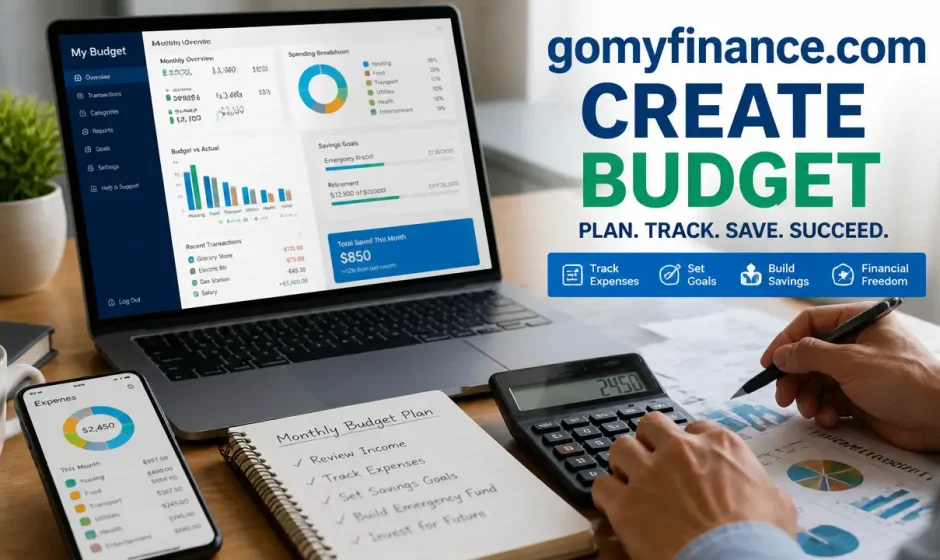

Managing money without a plan is like driving across an unfamiliar country without a map. You might eventually reach your destination, but the detours, wrong turns, and wasted fuel along the way will cost you far more than they should. Budgeting is the roadmap that keeps your financial life on track, and in today’s digital age, doing it manually on paper or in clunky spreadsheets is no longer your only option. GoMyFinance.com create budget has emerged as a practical, user-friendly platform where everyday people can create a budget, monitor their spending, and take genuine control of their financial futures.
This guide is written for real people — whether you are just starting out with your first paycheck, trying to get out of debt, building an emergency fund, or simply tired of wondering where all your money went at the end of the month. By the time you finish reading, you will know exactly how to use GoMyFinance.com to create a budget that reflects your actual life, not just an idealized version of it.
Why Budgeting Is Not Optional Anymore
There is a persistent myth that budgeting is only for people who are struggling financially. The truth is the opposite. The people who consistently build wealth — regardless of their income level — are the ones who know where every dollar is going. They are not depriving themselves. They are making intentional decisions.
Without a budget, lifestyle inflation creeps in silently. You get a raise, your spending adjusts upward to match it, and somehow you feel just as financially stuck as before. With a budget, that raise becomes an opportunity — to pay off debt faster, to invest more, or to finally take the vacation you have been postponing for years.
The average household wastes hundreds of dollars every month on subscriptions they forgot about, impulse purchases they regret, and financial decisions made without context. A budget does not just tell you where your money went — it tells you where it should go before you spend a single cent. That proactive control is the difference between reacting to your financial life and designing it.
What Makes GoMyFinance.com Different
There are dozens of budgeting tools on the market, and many of them are overwhelming, bloated with features most people never use, or designed primarily for financial professionals. GoMyFinance.com takes a different approach. The platform is built around accessibility and clarity — the idea that anyone, regardless of financial literacy level, should be able to create a budget that is personalized, realistic, and easy to maintain.
When you use GoMyFinance.com to create a budget, you are not handed a generic template and told to figure it out. The platform walks you through a process that accounts for your specific income, your actual spending categories, and your personal financial goals. It bridges the gap between knowing you should budget and actually having a budget that you use consistently.
The interface is clean and intuitive. Data entry does not require accounting knowledge. And the visual feedback — charts, summaries, and spending breakdowns — makes it easy to understand your financial picture at a glance, which is something most people can never get from a spreadsheet.
Getting Started: Setting Up Your Account on GoMyFinance.com
The first step to using GoMyFinance.com is creating your account. The registration process is straightforward — you provide your basic information and set up secure login credentials. The platform takes privacy seriously, which matters when you are dealing with sensitive financial information.
Once inside, you will be prompted to begin building your financial profile. This is not an intrusive data collection exercise. It is the foundation of your personalized budget. You will input details about your household, your income sources, and your general financial situation. Think of it as having an initial conversation with a financial advisor — one who is there to understand your circumstances before offering any guidance.
Before you dive into creating your budget, it helps to have a few things ready:
- Your monthly take-home income (after taxes and deductions)
- A general sense of your fixed expenses — rent, mortgage, loan payments, insurance
- Recent bank or credit card statements to reference your variable spending
- Any financial goals you are working toward, such as paying off a credit card or saving for a down payment
Having this information available makes the budget-creation process faster and more accurate. The more honest you are during setup, the more useful the output will be.
How to Create a Budget on GoMyFinance.com: A Step-by-Step Walkthrough
Step 1 — Input Your Income
The first thing GoMyFinance.com asks when you go to create a budget is how much money you bring in. This seems simple, but it deserves careful thought. If you are salaried, your monthly income is predictable. If you are self-employed, freelance, or work hourly with variable hours, you need to think about what to use as your baseline.
A useful strategy for variable income earners is to use a conservative estimate — perhaps the average of your three lowest-earning months in the past year. This way, you are budgeting for reality, not for an optimistic projection. Any income you earn above that baseline becomes a bonus that you can direct strategically.
GoMyFinance.com accommodates multiple income streams. If you have a side hustle, rental income, or regular freelance work on top of your primary salary, you can add all of these sources. The platform totals them into a single monthly income figure that your budget will be built around.
Step 2 — Categorize Your Expenses
This is where the real work happens, and also where GoMyFinance.com’s design truly shines. The platform provides a thoughtful set of default expense categories that cover the most common financial obligations most households have:
- Housing (rent or mortgage)
- Utilities (electricity, water, gas, internet)
- Transportation (car payment, fuel, public transit, parking)
- Groceries and dining
- Healthcare and insurance
- Personal care and clothing
- Entertainment and subscriptions
- Debt payments (credit cards, student loans, personal loans)
- Savings and investments
- Miscellaneous and unexpected expenses
You can customize these categories to fit your life. If you have a pet, you can add a pet care category. If you are a parent, school expenses and childcare have their own place. If you are managing business expenses alongside personal ones, you can separate those accordingly. The flexibility is what makes the GoMyFinance.com budget creation process genuinely personal rather than one-size-fits-all.
For each category, you will enter a monthly spending limit — how much you intend to spend, not necessarily what you have been spending. This is a crucial distinction. The goal is to set intentional limits based on your income and priorities, then work toward meeting them.
Step 3 — Apply a Budgeting Framework
GoMyFinance.com supports several approaches to budgeting, and understanding them helps you choose the method that fits your personality and financial situation.
The 50/30/20 rule is one of the most widely recommended frameworks for people who are new to budgeting. It divides your after-tax income into three broad buckets: 50% for needs, 30% for wants, and 20% for savings and debt repayment. It is simple, flexible, and has worked for millions of people who felt overwhelmed by more granular approaches.
The zero-based budget takes a more detailed approach. Every dollar of your monthly income is assigned a specific job — whether that is paying rent, buying groceries, building your emergency fund, or covering entertainment. At the end of the planning process, your income minus your assigned expenses equals zero. This does not mean you spend everything. It means every dollar has a purpose, including the dollars going into savings.
Envelope budgeting, traditionally done with physical cash in labeled envelopes, translates beautifully into digital form on GoMyFinance.com. You allocate a set amount to each spending category at the start of the month. When a category is empty, the spending stops. This method is particularly effective for people who struggle with impulse spending.
You do not have to commit rigidly to one method. Many users on GoMyFinance.com blend approaches — using the 50/30/20 rule as a high-level guide while applying zero-based logic to their most problematic spending categories.
Step 4 — Set Your Financial Goals
A budget without goals is just a list of numbers. Goals are what give your budget meaning and motivate you to stick with it when spending temptations arise. GoMyFinance.com has a dedicated goal-setting feature that lets you define what you are working toward and track your progress in real time.
Common financial goals include:
- Building a three-to-six-month emergency fund
- Paying off a specific credit card or loan
- Saving for a home down payment
- Funding a vacation or major purchase without going into debt
- Reaching a retirement savings milestone
When you create a budget on GoMyFinance.com and link it to a specific goal, the platform can show you how long it will take to reach that goal based on your current savings rate, and what adjustments would get you there faster. This kind of feedback is what separates a smart budgeting tool from a simple expense tracker.
Step 5 — Review, Adjust, and Activate
Once all of your income, expenses, and goals are entered, GoMyFinance.com generates a budget overview that shows you exactly where things stand. If your expenses exceed your income, the platform highlights the gap and suggests where adjustments could be made. If you have money left over, it helps you direct that surplus intentionally rather than letting it disappear into vague spending.
Take time to review this overview honestly. Does your dining out allocation reflect your actual habits, or are you being optimistic? Is your savings contribution realistic given your fixed costs? The best budget is not the most aggressive one — it is the one you will actually follow.
Real-World Case Studies: Budgeting in Action
Case Study 1 — The Young Professional Paying Off Student Debt
Marcus is 26, working his first job out of university, earning a decent salary but carrying significant student loan debt. Before using GoMyFinance.com to create a budget, he had no clear picture of how his money was moving. He knew he was making loan payments, but they felt endless, and he had nothing saved.
After setting up his GoMyFinance.com budget, Marcus discovered he was spending nearly 22% of his take-home pay on dining and entertainment — well above what he had guessed. By reducing that category by half and redirecting the savings toward his highest-interest loan, he was able to accelerate his payoff timeline considerably. More importantly, seeing the numbers clearly removed the anxiety he had been carrying about his debt.
Case Study 2 — The Family Managing on a Variable Income
Priya and her husband run a small business together, which means their monthly income fluctuates significantly. Before using GoMyFinance.com, they were perpetually reactive — spending freely in good months and scrambling in lean ones.
They used GoMyFinance.com’s income input feature to set their budget based on their lowest reliable monthly income. In months when they earned more, the surplus went into a business reserve fund they created as a separate budget goal. Within eight months, they had three months of expenses saved as a buffer, which transformed how they approached both their business and their household.
Case Study 3 — The Single Parent Rebuilding After Divorce
Sandra, a single mother of two, needed to completely rebuild her financial structure after a divorce left her managing all household expenses on her own income for the first time. The thought of budgeting felt overwhelming, even shameful, in a moment already filled with stress.
What GoMyFinance.com provided was structure without judgment. She was able to create a budget that accounted for her actual expenses — including childcare, school supplies, and healthcare — without feeling like she was being compared to an ideal she could not meet. The visual dashboard showed her small wins every time she stayed within a category’s limit, and those small wins compounded into genuine financial confidence over time.
Maintaining Your Budget: The Habits That Make the Difference
Creating a budget is the beginning, not the end. The most common reason budgets fail is not that the numbers were wrong. It is that people set the budget once and never revisit it. Life changes — incomes shift, expenses emerge, priorities evolve — and your budget needs to evolve with them.
The most effective budgeters tend to follow a simple monthly ritual:
Weekly check-ins are a powerful habit. Spending five to ten minutes each week reviewing your GoMyFinance.com dashboard keeps you aware of where you stand in each category. It is much easier to course-correct mid-month than to discover at month’s end that you blew your grocery budget in the first week.
Monthly budget reviews are where you close out the previous month and set up the next one. Look at which categories you consistently overspend and which you consistently underspend. Adjust the limits to better reflect reality, or identify the behavioral patterns driving the overspending.
Quarterly goal reviews give you a higher-level look at your progress. Are you on track to meet your emergency fund goal by the date you set? Is your debt decreasing at the pace you planned? These check-ins keep your long-term vision connected to your day-to-day decisions.
One of the most important habits is treating irregular expenses as monthly expenses. Annual insurance premiums, car registrations, holiday gifts, back-to-school shopping — these are predictable even if they are not monthly. Divide the total annual cost by twelve and budget that amount each month into a dedicated category. When the expense arrives, the money is already there.
GoMyFinance.com Create Budgets That Helps You Avoid The Common Budgeting Mistakes and How
Forgetting irregular expenses. As mentioned above, this is perhaps the single most common reason budgets collapse. GoMyFinance.com’s category system allows you to plan for these expenses in advance rather than treating them as emergencies.
Setting unrealistic limits. If you have been spending $600 a month on groceries for years, setting a $200 budget is not ambitious — it is a setup for failure. GoMyFinance.com encourages you to start with honest baseline numbers and reduce gradually as you build new habits.
Not separating wants from needs. Streaming subscriptions are not utilities. Dining out is not groceries. The more granular your categories, the clearer your spending picture becomes. GoMyFinance.com’s customizable category system makes this level of distinction easy to maintain.
Budgeting income before taxes. This is a surprisingly common error, especially for first-time budgeters. Always input your take-home pay — the amount that actually hits your bank account — not your gross salary. GoMyFinance.com’s income input process makes this clear from the start.
Giving up after one bad month. A budget is a long-term tool, not a pass/fail test. Missing a category limit in one month does not mean the budget is broken. It means you have data that helps you make better decisions next month.
Using GoMyFinance.com for Household Budgeting and Shared Finances
Managing money with a partner or within a household adds complexity that solo budgeters do not face. Income may come from multiple earners. Spending habits and financial values may differ. Priorities around saving and spending may need to be negotiated and aligned.
GoMyFinance.com’s approach to household budgeting acknowledges this complexity. When you create a budget for a household, you can consolidate multiple income sources and build a shared picture of where the family’s money is going. This shared visibility is enormously valuable for couples who have historically kept finances separate or simply avoided talking about money.
Having a shared budget — one that both partners have contributed to and agreed on — removes a significant source of financial tension from relationships. Disagreements about money become easier to resolve when both people are looking at the same objective data rather than working from different assumptions.
For families with older children, a household budget can also be a powerful teaching tool. Showing a teenager the actual cost of running a home — mortgage, utilities, groceries, insurance — creates financial literacy that no classroom lesson can fully replicate.
Saving Strategies You Can Build Into Your GoMyFinance.com Budget
A budget is only as powerful as the savings strategy it supports. Here are several approaches that integrate naturally into the GoMyFinance.com framework:
Pay yourself first. Treat savings as a non-negotiable expense — the first “bill” you pay each month, not the last item you fund with whatever is left. When you create a budget on GoMyFinance.com, add your savings contribution as a top-priority line item before anything else.
Use the sinking fund approach. A sinking fund is money set aside each month for a specific future expense. One fund for car maintenance, another for travel, another for holiday gifts. This method eliminates financial surprises because you are continuously preparing for them.
Build your emergency fund before aggressively attacking debt. This might seem counterintuitive, but having even a small emergency fund — $500 to $1,000 to start — prevents you from turning to credit cards every time an unexpected expense arises. GoMyFinance.com lets you set this as a primary goal and shows you how to fund it within your existing budget.
Automate where possible. The more you can remove willpower from the equation, the more consistent your savings will be. Set up automatic transfers to your savings account on the same day your paycheck arrives. Your GoMyFinance.com budget can help you determine exactly how much to automate.
GoMyFinance.com and Long-Term Financial Planning
Budgeting is a short-term tool, but its effects are long-term. The habits you build through consistent budgeting on GoMyFinance.com — tracking income, controlling spending, setting goals, reviewing progress — are the same habits that lead to meaningful wealth building over time.
As your financial situation improves and your goals evolve, your GoMyFinance.com budget should grow with you. A budget for someone early in their career looks very different from a budget for someone approaching retirement. The platform accommodates that evolution, giving you the flexibility to update your financial picture as your life changes.
Think of GoMyFinance.com not just as a tool for managing this month’s spending, but as the foundation of a lifelong relationship with your money. The people who build genuine financial security are not necessarily the ones who earn the most. They are the ones who manage what they earn with intention, consistency, and clarity — and a well-maintained budget is the most fundamental expression of all three.
Frequently Asked Questions About Using GoMyFinance.com to Create a Budget
Q: Is GoMyFinance.com suitable for someone who has never budgeted before?
Absolutely. GoMyFinance.com is specifically designed to be accessible to people at every level of financial experience. The step-by-step budget creation process does not assume any prior knowledge, and the interface is intuitive enough that most users feel comfortable within their first session. If you have never budgeted before, GoMyFinance.com is actually an ideal starting point because you will not have to unlearn bad habits from more complicated tools.
Q: How long does it take to create a budget on GoMyFinance.com?
For most users, the initial budget setup takes between twenty and forty minutes. This includes inputting income, setting up expense categories, and defining your first financial goal. Having your recent bank statements or spending records available speeds up the process. The time investment is small relative to the financial clarity you gain.
Q: What if my income changes month to month?
Variable income budgeting is one of the more challenging aspects of personal finance, but GoMyFinance.com handles it well. The recommended approach is to base your budget on your lowest expected income month, treat any additional income as surplus that gets directed according to your priorities, and revisit your baseline figure periodically as your income patterns change.
Q: Can I use GoMyFinance.com for business expenses as well as personal ones?
GoMyFinance.com is primarily designed for personal and household budgeting. Many self-employed users do use it to track business-related expenses separately from personal ones, but for complex business accounting needs, a dedicated accounting platform would be more appropriate alongside your GoMyFinance.com personal budget.
Q: How often should I update my budget?
Your budget categories and limits should be reviewed monthly. Your financial goals should be reviewed quarterly. Major life changes — a new job, a move, a growing family, a significant purchase — warrant an immediate budget review to ensure your plan still reflects your reality.
Q: What if I consistently overspend in a category despite my best efforts?
Consistent overspending in a category is data, not failure. It usually means one of two things: either your limit for that category is unrealistic and should be adjusted upward, or there is a behavioral pattern worth examining more closely. GoMyFinance.com’s tracking features make it easy to identify these patterns. Sometimes the solution is a higher limit; sometimes it is finding a creative way to reduce spending in that area without feeling deprived.
Q: Is my financial information secure on GoMyFinance.com?
GoMyFinance.com takes data security seriously and implements standard security protocols to protect user information. As with any platform where you are storing financial data, it is good practice to use a strong, unique password and to be thoughtful about the devices you use to access your account.
Q: Can GoMyFinance.com help me if I am currently in debt?
Yes, and arguably this is where a structured budget matters most. When you are managing debt, having a clear picture of your income and fixed obligations is essential to identifying how much you can realistically direct toward debt payoff each month. GoMyFinance.com allows you to create debt payoff goals and shows you the impact of different payment strategies on your timeline.
Q: Do I need to connect my bank account to use the platform?
GoMyFinance.com can be used effectively as a manual budgeting tool without connecting external accounts. Many users prefer this approach for privacy reasons or because the manual entry process keeps them more engaged with their spending. Check the platform’s current features for the most up-to-date information on account connectivity options.
Q: What is the best budgeting method for beginners?
For most beginners, the 50/30/20 rule is the most manageable starting point because it does not require micro-categorization of every expense. It provides structure without being overwhelming, and it is flexible enough to accommodate different financial situations. As you become more comfortable with budgeting, you can add more granularity to your categories or experiment with zero-based budgeting for greater precision.
Final Thoughts
Money does not manage itself. Left without structure, it flows toward whatever is easiest — impulse purchases, forgotten subscriptions, creeping lifestyle inflation — and away from the things that actually matter to you. A budget is not a punishment. It is permission — permission to spend confidently on what you value because you have deliberately accounted for everything else.
GoMyFinance.com provides the tools, the structure, and the clarity to make that kind of intentional financial life achievable for anyone. Whether your goal is getting out of debt, building savings for the first time, or simply ending the month without the nagging anxiety of wondering whether you can pay your bills, creating a budget on GoMyFinance.com is one of the most practical and impactful steps you can take.
The best time to create a budget was the day you got your first paycheck. The second-best time is today.
For More Visits: Urbanmagazine